

Spaces of Madness: Insane Asylums in Argentine Narrative. Lanham, MD: Lexington Books, 2014.
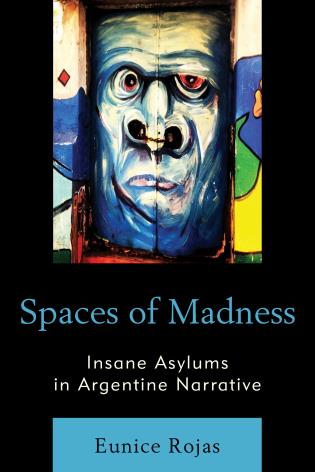
Spaces of Madness: Insane Asylums in Argentine Narrative examines the role of madness and irrationality in the works of four key Argentine novelists: Julio Cortázar, Ricardo Piglia, Juan José Saer, and Luisa Valenzuela. The works of the authors studied in Spaces of Madness reflect at times a wave of glorification of the irrational as a consequence of a growing distrust of rationalism. Often using the concept of madness as a metaphorical representation of an artistic type of irrationality, these works position madness as a means of resistance against supposedly rational forces of violence and repression. The works of the four authors studied here seek to dislodge reason, sanity and rationality from their pedestal by proposing madness as a metaphor for artistic efforts of resistance against the violent and repressive consequences of purported rationality taken to irrational extremes.
Excerpt from the Introduction
The first chapter of Spaces of Madness examines works published between 1889 and 1936 by Manuel T. Podestá, Horacio Quiroga, and Roberto Arlt. Podestá’s Irresponsable (1889) features a protagonist who feels progressively marginalized from society and is commited to an asylum in the final chapter of the novel. Quiroga’s “La lengua” (1906) and “El conductor del rápido” (1926) both feature Buenos Aires’ public men’s hospital, the Hospicio de las Mercedes. In the first story, a convicted
murderer narrates the details of a revenge killing of a man who has presumably slandered him in which his victim grows an infinite number of tongues to replace the ones the narrator cuts out. In the second story, a train conductor nearly drives a train off the tracks due to an attack of madness caused by the mechanization of modern society. Finally, in Arlt’s Los siete locos the pharmacist Ergueta is committed to the Hospicio de las Mercedes where he undergoes an out of body religious experience that culminates in a failed attempt to work a miracle. The failed miracle inside the asylum reflects the failed social revolution that is carried out outside the asylum.
Chapter 2 turns to the asylums depicted in Julio Cortázar’s Rayuela and Adolfo Bioy Casares’ Dormir al sol. Although the asylum itself occupies only a relatively small space in Cortázar’s most famous novel, the confusion between mad and sane characters inside the mental hospital, as well as the absurdity of the depiction of the asylum reflect the general attitude toward madness and irrationalism that the novel
examines. Bioy Casares’ Dormir al sol also depicts the asylum with a certain degree of absurdity as the protagonist has his wife committed to a private asylum that somehow manages to insert people’s souls into the bodies of dogs. The novels of both authors highlight the asylum as a place of power and manipulation that reflects the actions of authoritarian governments.
Chapter 3 examines the schizophrenic story-telling machine in Ricardo Piglia’s La ciudad ausente (1992) as an example of Gilles Deleuze and Félix Guattari’s notion of schizophrenia. Far from being equivalent to the clinical mental disorder, the use of the term “schizophrenia” in Deleuze and Guattari’s work is a free-flowing form of desire that serves to counter forces of Freudian repression. Piglia’s novel transforms the
Deleuzian schizophrenic desiring-machine into a story-telling machine that is sometimes portrayed as a woman committed to an insane asylum. While the Deleuzian machine and the desire it produces counter Freudian repression, Piglia’s machine and the narratives it produces resist against the forces of repression of the Argentine State as it seeks to erase from public memory the atrocities committed
during the Dirty War. La ciudad ausente uses the Deleuzian concept of schizophrenia to link the idea of madness to the notion of narration as a force of resistance against the State’s attempts to repress the public’s memory.
Chapter 4 follows Luisa Valenzuela’s portrayal of a passage through the space of madness in La travesía (2001). In her novels previous to La travesía Luisa Valenzuela’s characters systematically reject all possibility of their own madness to explain the often absurd and disturbing situations in which they find themselves. The reluctance on the part of these characters to consider the possibility that they might not be completely sane is not surprising since in all of Valenzuela’s
works prior to La travesía, in particular in Cola de lagartija (1983), madness has negative and violent connotations and is often associated with the military leaders responsible for the atrocities of Argentina’s Dirty War. In La travesía, however, Valenzuela’s conception of madness undergoes a transformation as the protagonist, through two parallel allegorical journeys into and back out of first a mental hospital and then a wilderness, discovers in herself a form of madness that is a metaphor for the artistic and literary pursuits that allow healing from and resistance to the repressive forces at work during the Dirty War and the years following it. Critical to the arrival at this new notion of madness for both the protagonist and the reader of La travesía is an understanding of the notions of René Girard’s theories of violence and sacrifice.
Chapter 5 examines Juan José Saer’s La pesquisa (1994), a detective novel in which the detective ends up committed to an asylum and accused of the very crime he was attempting to solve. La pesquisa, on the other hand, is set in contemporary Argentine and Parisian societies and uses the narrative of a crime story in which madness and sanity are hopelessly confused, as the ending leaves the reader unable
to determine whether or not the detective and the crazy killer are, in fact, one and the same. Baudrillardian simulacra appear throughout the novel to highlight the impossibility of distinguishing reality from its simulation. While focusing on madness as representative of the unknowability of truth, the novel also highlights the failure of
reason to successfully solve several other mysteries, including the identity of the anonymous author of a manuscript of a novel and the fate of the thousands of people who disappeared in Argentina’s Dirty War, in particular the narrator’s brother and sister-in-law.
Chapter 6 of Spaces of Madness returns to Juan José Saer to explore the travelling asylum in Las nubes (1997) as an Argentine foundation myth. The story in Las nubes explicitly parallels the journey of a young psychiatrist leading patients across the Pampa to a new mental clinic in Buenos Aires with Aeneas’ founding of Rome in Virgil’s Aeneid. The implication of this intertextuality is to posit a foundational myth for Argentina in which the nation has madness at its very origin. Far from many of the madhouses described by Foucault, the groundbreaking new mental clinic in Las nubes touts innovative and more humane treatment of its patients. The deranged patients led along this journey and the doctors who treat and seek to understand them stand in contrast with the vicious political forces that eventually demolish the
hospital and scatter its former patients across the pampa. The diagnosed madness of the patients is, as a result, proven to be far less destructive than the brutality and unreasonableness of the government forces acting under the cover of reason.
Finally, chapter 7 explores the figure of the poet Jacobo Fijman, who spent nearly half his life committed to the Borda Hospital in Buenos Aires, through the works of Vicente Zito Lema, Leopoldo Marechal, Abelardo Castillo, and Andrés Allegroni. Zito Lema, who sought out the poet in the Borda Hospital just two years before his death, published not only interviews with the poet but also essays and stories based
on his observations of the Fijman’s experience in the asylum. Marechal includes a character named Samuel Tesler who is modeled on Fijman in his novels Adán Buenosayres (1948) and Megafón, o la guerra (1970). In the later novel Tesler is sprung from the Borda Hospital in order to participate in a war that is being planned to save Argentina from its evils. Castillo’s novel, El que tiene sed (1986) features a
chronic alcoholic who voluntarily commits himself to the asylum in order to seek out a poet named Jacobo Fiksler in order to understand the poetic and spiritual nature of his own thirst for alcohol. Lastly, Allegroni’s novel Crónica de sombras: sobre escritos inéditos de Jacobo Fijman (2011) is a fictional diary alleged to have been written by
the poet including short stories that detail sinister and secret experiments carried out by the psychiatrists of the Borda Hospital with the intention of eradicating the world of madness due to its unintelligibility within the world of reason.
 Eunice Rojas